Elf’s psychiatric hospitalization
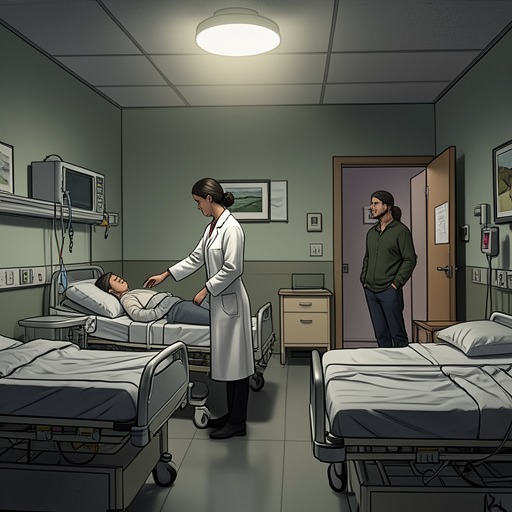
All My Puny SorrowsElfrieda Von Riesen’s psychiatric hospitalization is a struggle over who gets to define her condition and what care requires: the patient who cannot always speak, the family trying to understand her, or a hospital that expects cooperation and ordinary communication. The ward offers some attentive care, but its routines and repeated assurances also leave her family fearing that a discharge could come before she is safe. As the family tries to keep her alive, the limits of their influence become painfully clear.
Admission and the language of distress
Elfrieda’s exchanges with Janice reveal how effortful even a brief encounter can be. When Janice tries to catch her eye, Elfrieda turns away; at her sister Yolandi’s prompting, she slowly turns back. She is angry, chiefly at herself for having failed, but works to remain polite because good form has become her rule. The change in her private mantra is telling: she had once repeated the idea of love, but the word came to feel doomed, like a wax effigy, and its repetition ended in panic and weeping. Her distress is not presented as a simple refusal to engage. The words meant to console her have themselves become difficult to bear.
Elfrieda explains her estrangement from the world through the story of a man blind from birth who could see after an operation, only to find the newly visible world unbearable. She says she has never adjusted to the light of reality. Yolandi argues that she should stop repeating a word that makes her feel worse, but Elfrieda says that their exchanges are not ordinary conversations: they are attempts to work things out. The mismatch between Yolandi’s practical advice and Elfrieda’s account of how she experiences reality follows them into the ward, where communication itself becomes part of the struggle.
Another image gives that distress a bodily form. Elfrieda tells Yolandi that there is a glass piano pressed against the lower right side of her stomach, and fears both that it will push through her skin and that it will break inside her. She describes it as an old upright Heintzman, once a player piano, with its mechanism removed and the entire instrument, including the keys, made of glass. Bottles thrown into a garbage truck, wind chimes, and a particular bird’s song can make her fear that it is breaking. One morning, a visiting child’s laughter sounds to her like shattering glass, and she clutches her stomach. Yolandi responds by accepting the terms of the fear rather than dismissing it. The image makes her terror legible to her sister, even as it shows how ordinary sounds can become threats within her experience.
Communication and care on the ward
The hospital’s approach to expression is not consistent. Janice introduces art therapy, carrying paint tubes and rolls of paper, and explains that many patients can express themselves more easily through art than through language. Yolandi, in a small room with Janice’s hand on her shoulder, struggles to speak about the medication: she wants to know what the pills contain and whether they create meaning, flatten feeling, or intensify what is already in Elfrieda’s mind. Her questions are not answered in the scene. Instead, the ward’s calendar remains stuck in March though it should be April, an incongruity she stares at while trying to hold back words. The moment juxtaposes an offered means of expression with the family’s unanswered questions about treatment.
That promise of accommodating different forms of communication is sharply contradicted by the psychiatrist’s response. Yolandi explains that Elfrieda is willing to write, but he refuses to exchange notes, saying he has no time to read while working and that she must attempt to communicate normally if she wants to get better. The objection is not that Elfrieda has nothing to say; it is that her means of saying it requires time the doctor will not give. Yolandi tries to frame her silence as a challenge a psychiatrist should be prepared to meet, but he responds by asking who she is. The encounter leaves her without the conversation about her sister’s care she came to seek.
The pressure to cooperate also becomes a family dispute with the hospital. Lottie, speaking to a nurse outside Elfrieda’s room, says that her daughter has not seen a doctor in days. When the nurse agrees that Elfrieda is a human being but insists she is also a patient expected to cooperate, Lottie questions why cooperation should be treated as a condition of getting well. She argues that Elfrieda should eat when she chooses and should not be forced to talk. Her intervention makes visible a conflict between the ward’s demands for manageable participation and the family’s insistence that a patient’s refusal or silence should not erase her personhood.
Family vigilance and threatened discharge
Yolandi watches the ward for signs that Elfrieda may be sent home before her family can protect her. In a hallway alcove overlooking the parking lot and fields, she weighs taking her sister at face value against assembling a team immediately. She fears that if Elfrieda follows the rules and tells the staff she feels well and is not suicidal, she will be released in time for dinner. The fear is sharpened by the family’s earlier experience: Elfrieda and Yolandi had begged a hospital in East Village not to release their father, but he was allowed to leave and was gone for good. For Yolandi, assurances about discharge are not abstract; they echo a loss the family has already lived through.
The ward’s ordinary interactions offer brief counterweights to that fear. Elfrieda’s roommate, Melanie, joins a conversation from behind a curtain and is told to mind her own business; she replies that she is not there on business. Later, Yolandi finds Lottie holding Elfrieda’s hand and singing the childhood song Du, about enduring love despite the pain of loving deeply. Elfrieda holds her mother’s hand. The scene locates care not in an instruction or clinical procedure but in a familiar song and a physical connection, while the preceding and following moments leave the question of safety unresolved.
The family’s vigilance becomes repetitive and exhausting. Nic visits the hospital, usually twice a day, but reports little change and says that Elfrieda’s psychiatrist is rarely available. Lottie visits less often because she cannot bear the situation. Yolandi calls the nurses’ desk for updates and reassurance, sometimes late at night, asking whether Elfrieda is still there; one nurse tells her to go to bed, and Yolandi begins to object before stopping herself and apologizing. The calls show how care for someone confined to a ward can become a cycle of waiting for information, seeking reassurance, and trying not to antagonize the people who control access.
The promise of safety and its collapse
Yolandi is not only trying to prevent a premature discharge; she is also trying to raise money to take Elfrieda to Zurich. While she works on that plan, she asks Nic whether Elfrieda has mentioned coming to Toronto to live with her. Nic says he has not heard the idea, but sees no reason she could not come if she wants to. The possibility of a different living arrangement sits beside, rather than resolves, the immediate crisis in the hospital.
During this period, the staff berate Elfrieda for not following the programme, lecture Lottie about tough love, and threaten shock therapy. Yolandi continues calling to ask that her sister not be released. The nurses tell her they will not let Elfrieda go and at times try to calm her by telling her to make tea. Yet the hospital also makes communication conditional: Yolandi can speak with Elfrieda only if she comes out of her room and answers the phone in the recreation area. When Nic puts a phone to Elfrieda’s ear during a visit, Yolandi explains that she is still working out what to do and will come back to Winnipeg. At first Elfrieda does not speak. On a later call, her voice is clear and strong as she asks when Yolandi is coming to get her. The sudden directness punctures the long silence without making the plan or the danger disappear.
The promised safety fails at the moment Yolandi believes she has secured more time. She tells Elfrieda that she expects to have money soon for the trip to Zurich, but the next morning Lottie says the hospital is giving Elfrieda a day pass to celebrate her birthday. Nic is on his way to collect her; Lottie plans a cake, champagne, and flowers. Yolandi realizes that her absorption in keeping Elfrieda hospitalized until she can fund the trip has made her forget the birthday. The day pass sounds, to her, less like reassurance than the beginning of a separation she cannot control.
After news of what has happened reaches Yolandi, a hospital executive director calls to explain. Yolandi asks why the hospital let Elfrieda go after promising day and night that it would not. The executive director pauses the conversation to take a call from the police concerning the situation. Yolandi recognizes that she does not have to remain on hold or accept the institution’s framing, ends the call, and helps Nora pack for Winnipeg. The available account leaves the institutional assurances exposed by their failure: the family had repeatedly been told Elfrieda would not be allowed to leave, yet those promises could not protect her. Her hospitalization is therefore not only a setting for distress but the site of a consequential conflict over listening, autonomy, and responsibility, ending in a loss the family’s vigilance could not prevent.